‘See No Covid, Hear No Covid, Speak No Covid’


Between 20,000 to 25,000 Australians died from Covid in 2022, according to Professor Brendan Crabb AC Director & CEO of the Burnet Institute. “  These people would have lived if not for COVID. The scale of the tragedy is enormous. And the silence deafening. ”

An additional 1586 people died just in the first 27 days of 2023. One Australian is now dying every 30 minutes from Covid.

Prime Minister Anthony Albanese quite correctly expressed his condolences when one Australian was killed in an airplane crash in Nepal recently. But he and the State Premiers have been silent about the alarming death toll from Covid in Australia. No emergency National Cabinet meeting has been held. No public health statements or measures have been announced. No reports or accurate official information about deaths and illness have been made public. Both the and State Governments have adopted a ‘ See No Covid, Hear No Covid and Speak No Covid’ policy.


There are warnings in the media now that cases in China could hit 900 million, and that Australia should brace itself. The highly contagious XXB.1.5 variant is already the dominant type of Covid in Victoria.  Australian scientists, doctors and researchers are publishing reports and issuing dire warnings in the media and on social media.

But Australia’s PM Albanese and State Premiers still remain silent.

Health Minister Mark Butler merely mumbled something vague to Laura Tingle on ABC 7.30 about ATAGI possibly approving a 5th bivalent booster early this year.


Bivalent 5th Booster

The availability of the bivalent booster is an extremely important matter. The XBB.1.5 virus is considered more immune-evasive than previous versions of the virus. However, the bivalent booster in people aged 65+ has been shown to be very effective in reducing deaths by 86% deaths and hospitalisations by 81%. (See image above).


An Australian study published in the Medical Journal of Australia as recently as 28 November 2022 found that “ Hospitalisations of people with myocarditis and pericarditis, pulmonary embolism, acute myocardial infarction, and stroke were significantly more frequent after COVID‐19,” and they concluded that “ Our findings reinforce the value of COVID‐19 mitigation measures such as vaccination,”

And indeed in Australia, deaths from ischemic heart disease have now lurched 17 per cent higher than would be expected in a normal year.

Nevertheless, the Albanese Government is withholding release of the 5th bivalent booster for vulnerable and people aged 65+.  Most people in this age group had their 4th booster around April last year, so they now have little if any immunity. People in aged care are particularly vulnerable and they represent the majority of those dying.

Effectively, the Australian Government is leaving Australians defenceless.


Covid & Long Covid Damaging Economy

The Government’s ‘ See No virus, hear no Virus and Speak no Virus” approach is to create the impression that Covid is over so that the Australian economy can boom unimpeded.

Except that it won’t. This month, the U.S. Federal Reserve Chair, Jerome Powell, when discussing the US economy, bemoaned the fact that “close to half a million who would have been working ..died from Covid ”.

And let’s not forget the impact on people and the economy of Long Covid. One in ten people will end up with Covid, according to what has been described as a ‘jaw dropping study’ of the effects of Long Covid. Professor Eric Topol reported that even with mild cases of Covid,  “One year after the initial infection, severe acute respiratory syndrome coronavirus 2 (SARS-CoV-2) infections increased the risk of cardiac arrest, death, diabetes, heart failure, pulmonary embolism and stroke,”.

Although the Albanese Government has had some significant successes in a range of policy areas since it came to office, it is now showing total dereliction of its duty to protect Australians in this national health crisis.


Ageist Budget Leaves Older Women Out


Budget 2022-2023 has been presented as a budget for women. Certainly if you are a woman with young children, you will benefit from the welcome changes to childcare and parental leave. But if you are a woman over the age of 50, you are as invisible to this Labor Australian Government as to the previous LNP Government.

There is a fundamental failure of Government to see the major social crisis specifically affecting the demographic of women aged 50+. They constitute a third of Australian women. From their mid-40s on, they start to lose jobs and find themselves unemployable because of their age. The below poverty level Jobseeker and pension payments leave them unable to pay increasing rents, mortgages, energy and food costs. Most have little or no super and growing numbers inevitably find themselves impoverished and homeless.

The economic insecurity and social exclusion of this demographic is a distinctive social phenomenon that demands a distinctive, holistic approach.

‘Motherhood Penalty’ but no ‘Age Penalty’

Budget 2022 includes an 82 page Women’s Budget, but this too failed to acknowledge the economic, social and health disaster that is engulfing tens of thousands of older women precisely because they are becoming older women.

The Women’s Budget Statement lists women’s economic equality as one of its 3 key themes. The Budget quite correctly goes into detail about  the ‘motherhood penalty’ on work, income and advancement. But there is nothing about the ‘age penalty’ for women. It talks about the need to remove the barriers to workplace participation for women, but it lists only child care and unpaid work. There is not a single word about the widespread ageist barriers that prevent the participation of older women in the workforce and their pay equality. Consequently, there are no Government measures listed to address these barriers that precipitate the economic insecurity of older women.

Modelling shows that the Budget’s parental leave pay, child care subsidies, and the stage 3 tax cuts will provide high income couples with children with an extra $9,763 a year, while the lowest income couples with children will only get $194. Older women without children will get zero. Jobseeker and the pension may rise slightly, but that is an automatic adjustment to inflation and not something the Government can continue to claim credit for as they tried to do in September.

So women aged 50+ on $17,000 a year, $48 p.d., will have to cope with 8% inflation, a 56% increase in electricity costs and a 40% increase in gas costs. That’s in addition to skyrocketing rents and mortgage interest rates. The impact of the Government’s neglect of women aged 50+ will be devastating.

Homelessness

Budget measures on the national housing crisis are certainly commendable and necessary, but they are essentially long term projects.  And the provision of emergency relief for individual cases of women experiencing housing stress is inadequate. What is needed is a recognition that older women constitute the majority of those who are homeless and that this is a demographic-wide issue and must be immediately and specifically addressed on a large scale. The $4,000 social housing units planned are impossibly inadequate. With regard to rentals, the Budget offered no review or increase to Commonwealth Rent Assistance and no immediate relief.

The Government’s failure to act is entrenching a class of impoverished older women in Australia. It is also sending a serious message to younger women. It is saying that beyond your fifties, expect to go over a cliff because you will be on your own unless you are a woman of independent means.

It could be quite different. The Australian Government’s claim that it cannot afford to increase social welfare payments because of the inherited Budget deficit is not convincing. Finland and Norway have successfully imposed a windfall tax on energy companies thereby enabling these Governments to improve the welfare and wellbeing of their people.

Bread and Butter Budget

It is disingenuous of Treasurer Jim Chalmers to describe this Budget as a ‘wellbeing’ Budget. It totally ignores the wellbeing of women beyond their 50s. His description of it being a ‘bread and butter’ Budget is more accurate. Because this is probably all that these women will be able to afford in the coming years.


The 50 Over 50

Recently, Forbes published a list that defies conventional beliefs. It is ’The 50 Over 50’, a list of women who have become successful and powerful after the age of 50, with some even in their nineties. This list is produced in partnership with Mika Brzezinski, host of MSNBC’s Morning Joe and her Know Your Value Initiative. It is the second annual list of ’50 Over 50’.


Why is it important to publish such a list? Because one in two people in the world hold ageist views according to UN figures. Because the older a woman becomes, the more she is devalued. Yes, older people are generally considered to have less value than younger people in our society. But older women fare worse than their male peers.

This deprecation and depreciation of women as we age, is deeply entrenched in the English language. As editor of WomanGoingPlaces, I wrote an article entitled 999 Ways to Describe an Older Woman after I found out that Google offers 999 adjectives and nouns to describe an older woman. Nearly all are pejorative.

Older women imbibe this loss of worth and it becomes part of their self-image. That is precisely why WomanGoingPlaces has continued to publish and aggregate the stories of remarkable Australian women in order to challenge these negative stereotypes. This is the same motivation behind the publication of the ’50 Over 50’ list.

And it is the reason a list like ’50 Over 50’ can be transformative.

Not every woman can realise the extraordinary success and achievements of many of the women in these lists. But they can recognise that the debasement of older women is based on lies. They can also recognise that this prejudice is destructive to them individually, and they can reject it. Lists such as ’50 Over 50’ can be life affirming and age affirming to older women.

You can’t be it if you don’t see it

The slogan – “ You can’t be it if you can’t see it ” – is a powerful tool in promoting role models for young girls to emulate the success of adult women.

But older women also need role models. Not only in order to combat negative stereotypes. We need role models because never before in history have millions of women had to navigate unprecedented longevity. We are also the first generations of women with decades of experience in higher education, the professions and the workforce, but with few precedents of how to age – other than the stigma of being a burden on society.

We fully recognise that ageing brings the very real danger of poverty and homelessness for too many older women. That is precisely why WomanGoingPlaces became a social enterprise advocating for the economic security and social inclusion of women aged 50+.

But we also need to be aware that this is not the full spectrum of experiences for older women, and that along with the dangers, there are also the opportunities.

“For many of the women on the list, their success and innovative thinking is not in spite of their age, but instead, a direct result of it, ” says Deborah Kilpatrick, the 54-year-old co-CEO and executive chair of Evidation Health, a digital health company worth $1 billion.

We need to create new models of ageing.

They may also help to balance or reduce the prejudice of the rest of society.

Jobs Summit Fails to Address High Unemployment of Women 50+

We have just seen Australia’s national leadership convening in Canberra to examine the barriers to employment, but failing to even look at the distinctive barriers that exclude older women – a third of Australia’s female population.

It is a matter of great concern that this issue was not addressed, according to the official Outcomes of the Summit. I am referring to women aged between 50 and 66, and not pensioners.

Treasury published the 36 Outcomes of the Summit which included “embedding women’s economic participation and equality as a key economic imperative. We will work towards reducing barriers to employment and advancement so that all Australians benefit from a strong economy.” 

The Summit addressed gender parity, parental leave and childcare. It also referred to sexual harassment at work.

But why did it not address one of the key barriers facing women without small children. Women over 50+ locked out of the workforce by the impenetrable barrier of ageism? 

The AHRC found that half of employers would not employ women of this age.

Surely that is a significant barrier in the Australian economy to the participation of women in the workforce. So why was it not addressed as such?

In a previous article, I put 4 Questions to PM Albanese and Treasurer Chalmers as to whether the Jobs Summit would address the escalating economic crisis facing women aged 50+. This demographic constitutes the majority of the those are unemployed, the majority on Jobseeker, and those who are on Jobseeker for the longest periods. They also represent  the majority of Australians becoming impoverished and homeless.

Danielle Wood CEO of the Grattan Institute referred to older workers in her excellent speech saying “ it is equally important that we tackle both the economic and structural barriers to other groups participating to their fullest, including Australians with disabilities, our First Nations people, and older Australians.”  

However, older women face both greater barriers and more discrimination than older men. Ageism combines in a toxic mix with sexism to diminish older women’s value even further and reduce their likelihood of employment.

There are multiple barriers and issues related to the unemployment of women aged 50+. Therefore, why is it that  not a single unemployed woman aged 50+ had a voice at the Summit as a representative of this largest cohort of unemployed? It was right and proper for Dylan Alcott to speak regarding disability employment. Why does this right not extend to older women if one of the key objectives of the summit was to boost the participation of women in the workforce and remove the barriers they face?

Older women feel themselves to be invisible socially. They are also being excluded from economic reform and opportunities.


Jobs and Skills Summit – 4 Questions

There is a direct causal link between a woman’s age in Australia and her likelihood of becoming unemployed and homeless. Women aged 50+ are the majority on Jobseeker and they are on it for the longest periods. They also constitute the largest numbers already homeless or at risk of homelessness. A key reason for this is that women aged 50+ are locked out of the workforce by widespread ageism. Furthermore, women aged 50+ have little if any super to fall back on.

The reality threatening countless older women is that should they lose their jobs, they are unlikely ever to find work again.

The Jobs and Skills summit is scheduled for 1st and 2nd September in Canberra. 

So my 4 questions to you PM Anthony Albanese and Ministers Jim Chalmers, Katy Gallagher, Tony Burke , Julie Collins,  Brendan O’Connor, Mark Butler, Linda Burney, Amanda Rishworth, Clare O’Neil, and Ed Husic are:

QUESTION 1

Why is this crisis that is engulfing Australian women aged 50+ not on the agenda of the Jobs & Skills Summit?

There are only vague points on the agenda about: “expanding employment opportunities for all Australians including the most disadvantaged” and “ensuring women have equal opportunities and equal pay.”

The economic security of women aged 50+ is an issue of national importance. Thirty-five percent of Australian women are aged 50 and over. Over 400,000 older women were already homeless two years ago, and given inflation and the state of the economy, these numbers will have escalated considerably. 

The Summit must focus on the particular circumstances causing the high rate of unemployment of older women. Official unemployment statistics do not accurately reflect the number unemployed. This is because many of these women have dropped out of seeking paid employment after countless rejections due to their age.

This further contributes to the exploitation of women aged 50+ by turning them into a massive unpaid workforce. Almost a quarter of women aged 55-64 do unpaid care work. It is worth $650 billion to the Australian economy, equal to 50.6% of GDP. But this work is not included as valued work in GDP figures.

Unfortunately, the age discrimination older women face is generally not a factor in gender equity discussions. It is repeatedly overlooked, even by women’s groups. It must be examined as a specific stand-alone issue by the Jobs & Skills Summit.

QUESTION 2

Will the Jobs and Skills Summit address the workforce experience of women aged 50+ and present programs to provide them with training where required?

We are constantly hearing about a skills shortage and lack of people to fill jobs. This is immediately followed by calls to increase immigration and foreign workers. The existence of this large demographic of unemployed older women is overlooked in all the discussions.

They are in fact a vast resource for the nation. It must be noted that we are talking about women who have spent decades in the workforce. They have experience, knowledge, professional skills and academic qualifications.  They may need re-training for requirements of particular jobs, but that applies to many applicants of any age group. 

The latest findings from the 2022 Skills Priority List, released by Prime Minister Albanese, show that four of the top ten in-demand professions over the next five years will be in the care, health and education sectors. Many women aged 50+ have either already worked in these sectors during their careers or they can be re-trained. Let’s not forget that so many older women are eminently qualified to work in the caring economy, having undertaken unpaid caring work experience throughout their lives.

QUESTION 3

Will the Government recognise at the Jobs and Skills Summit that the amount the Government pays in Jobseeker is a direct cause of the impoverishment of older women and will it immediately raise the rate? 

The current maximum rate of Jobseeker is about 40 per cent of the minimum wage. Even if Jobseeker were doubled, it would still be well below the minimum wage. It is impossible to survive on this amount.

The Government argues it has no funds to prevent older women becoming impoverished and homeless. There is however a source of funding that the Government still refuses to tap. Nobel Prize winner Joseph Stiglitz and UN Sec-Gen Antonio Guterres, Ken Henry amongst others, have called for a windfall tax on energy companies which pay almost no royalties or tax on Australian resources. This is what Norway has done, why can’t we? This year alone, Norway, with a population of 5 million, collected around $170 billion from its oil industry.

Question 4

Will the Government use the Jobs and Skills Summit to announce emergency changes to WorkForce Australia?

This system of job providers and mutual obligations has already been exposed as a cruel system rigged to produce profits for private operators, and not jobs for the unemployed.  

It is particularly harmful to women being rejected for jobs because of age discrimination. 

Tony Burke has announced a committee to look into WorkForce Australia, but its findings are not due for another year. If these women are forced to live so long under these conditions, many will die. How can the Government abandon such a significant part of the Australian population?


Government Integrity – It’s Not Just About Money

This is the first Australian election in which the integrity of government featured as a key election issue and played a part in the change of government. 

So how should we measure the integrity of the LNP Government under Prime Minister Scott Morrison?

One measure is Australia’s ranking on the international index of corruption. The latest Corruption Perceptions Index  gave Australia its worst ever score and lowest ranking.

An ICAC at the federal level would have scrutinised the misuse of public funds, rorts, slush funds, pork barrelling and lack of transparency. But Scott Morrison successfully avoided honouring his 2019 election promise to establish one. We await the announcement of an ICAC from Prime Minister Anthony Albanese.

However, the integrity of a government is not only measured by its handling of public funds. The integrity of a government must also be measured by the way it governs, and whether it governs in the public interest and serves the common good.

By this measure, the LNP Government under Scott Morrison corrupted its mandate to govern in the national interest.

It did so in two basic ways.

First, it governed by dividing the Australian population into adversarial camps and favouring one camp over the other.

Secondly, it divested itself of some of the fundamental roles and Constitutional responsibilities of government. It shrank the mandate of government.

Dividing the nation

In effect, the Morrison Government divided the nation into those who were worthy of receiving government support and public funding, and those deemed unworthy. This was determined by a deeply ingrained ideological mix of neoliberal conservatism, religion and toxic masculinity. It gave preference to personal, party and and sectarian interests that furthered the Government’s primary purpose of retaining power.

This attitude was clearly demonstrated in the way public funding for the vulnerable was labelled ‘welfare’. The Government constantly sought to curb what it considered to be a drain on the budget by ‘non-productive’, ‘leaners’ in society. Relentless, illegal measures such as Robodebt were used to claw back any suspicion of overpayment of ‘welfare’. The scheme drove many people to suicide and actually ended up costing taxpayers $2 billion.

Even when the Morrison Government was headed out the door days just before the elections, it carried out one last act of cruelty toward welfare recipients. As of July this year, all those on Jobseeker will have to fulfil a draconian  “points-based activation system (PBAS)” for mutual obligations. It is impossible to do this without access to the internet. Women aged 50+ constitute the majority of those on Jobseeker. On $46 p.d. they cannot even afford housing or adequate food let alone the internet. This points system will strip them, and chronically ill and disabled people who are on Jobseeker, of even this below subsistence level income.

By comparison, the use of taxpayers funds for wealthy, corporate and allied interests was abundant and characterised as productive, irrespective of any evidence to the contrary.

The Government consistently brushed aside suggestions that it recoup $40 billion of taxpayer funds lavished without scrutiny via Jobkeeper on profitable businesses.

Taxes were skewed so that proportionally a nurse pays more tax than the giant gas corporations. New analysis of data published by the Australian Tax Office (ATO) shows that five of the gas industry’s most prominent companies have paid no income tax for at least the past seven years, despite a combined income from their Australian operations of $138 billion.

This is not about ‘small government’. It is about a government that favoured the few.

The previous Government’s failure to develop and implement a comprehensive climate change policy is a glaring demonstration of this same preference to serve fossil fuel, political and vested interests over the national good. Hard to forget the payoff in public funds that Barnaby Joyce received for giving the Prime Minister permission to attend the G20 on climate change. Nor the seemingly unlimited public funds allocated to subsidise fossil fuels.  Meanwhile those who were deemed to be not so worthy, were left with burnt or flooded homes, bereft of government support and funding.

The Morrison Government also managed to cleave the country in two along gender lines.

PM Morrison’s ‘women’s problem’ was a direct consequence of the ideological bias of his Government. That is why his Government would not support gender pay equality or fully funded childcare.

The Government’s priority was to protect its ministers against historic and recent allegations of rape, sexual abuse and violence. This was also why the Government ensured Parliament would not adopt all the recommendations of the Respect at Work report. And when women protesters converged on Parliament House from around the country, the Prime Minister refused to even step outside to listen to them. So they delivered their rage through the ballot box.

Shrinking the mandate

The second way in which the Morrison Government corrupted its mandate to govern in the national interest was by increasingly divesting itself of the fundamental roles and responsibilities of government. Health, housing, aged care, employment and education, were neglected, drastically underfunded, outsourced or privatised under the LNP. 

“It’s not my job” became the common refrain from Prime Minister Morrison.

The Constitution mandates that the Federal Government is responsible for aged care. But the Morrison government chose to offload this responsibility onto private operators. These operators were generously compensated with public funds without proper government oversight. And as the Royal Commission found, led in consequence to an appalling state of overall  “neglect” in aged care. 

Despite all this, one of the last announcements of the Morrison Government was that aged care operators would receive an extra $3 billion in government funding to improve food. But they were assured that they do not need to provide “spreadsheets or evidence”, even though a third are still spending less than $10 a day per person on food.

Another Government responsibility that was stealthily outsourced is pensions. The Government was bent on handing control of pensions over to private operators and severely restricting the use of these cards by pensioners. Over $170 million of public funds were funnelled into the pockets of the private operators of the Indue card. One of the first acts of Labour’s Minister Amanda Rishworth has been to quickly abolish this card.

On health

The LNP Government actively undermined universal healthcare by stripping 900 items from Medicare and left hospitals on the point of collapse.

On education

Universities and public schools were starved of funding while  $769 million in Jobkeeper was made available to private schools.

On housing

No funds were allocated to build social housing in recent government budgets. Nor were there any policies to address housing supply and affordability. The last-minute election eve announcement about allowing people to raid their super funds was another example of a government taking no responsibility to solve a crisis, but handing the task over to the individual.

A Government that was actively shrinking its constitutional responsibilities was never going to initiate a referendum to change the Constitution to enshrine a Voice for First Nations Peoples. 

Not only did the LNP Government narrow its responsibilities to further the nation’s welfare, it also hollowed out the institutions and instruments of government. The public service was denigrated, slashed and circumvented by a government that preferred to fund a costly stable of private, compliant consultants, devoid of scrutiny. Just days before the election, the Government announced it would cut a further 5,500 jobs from the public service.

Democracy in danger

After three years of the Morrison Government, Australia has been left with growing inequality and constricted national aspirations. It left a policy vacuum and a lack of ambition and direction at the national level. It saddled the country with extraordinary debt with little to show for it. It contributed to social fragmentation and levels of poverty and homelessness that Australia has not previously experienced. It increased the alienation of growing numbers of people because inequality seems insurmountable. It undermined trust in government and the belief in social justice.  

Democracy is eroded when governments subvert their mandate to govern in the interests of the whole population.

Government for the few is government without integrity.


Published in Independent Australia  

 

Election Issue Universally Ignored

There is one issue that has been universally ignored in this election campaign by the major parties and the independents. That is, the social crisis engulfing women aged 50+. These women make up 30% of the female population in Australia, but they constitute the majority on Jobseeker, the majority of those who are locked out of the workforce by ageism and the majority of the homeless. There were over 400,000 older women already homeless or at risk of homelessness. Now, with the CPI at 5.1%, tens of thousands more will become homeless as they give up trying to survive on the obscenely inadequate amount of Jobseeker at $46 p.d.

Then there are the tens of thousands of unemployed women aged 50 plus who do not even appear in the much lauded 4% unemployment figure. This is because they have given up applying for work. After an endless number of rejections, they know that most employers practice age discrimination and will not even consider hiring them.

And yet, it is not an election issue. The Government won’t raise the rate of Jobseeker or build social housing. The Opposition under Anthony Albanese refuses to commit to raising Jobkeeper, and its plans for social housing provide very little housing for older women. The newly announced home ownership scheme Help to Buy will only help those with the money to pay 2% deposit and it is limited to 10,000 people.

The silence of the teal independents on this issue is extremely disappointing. Particularly since most of them are 50-ish women. As candidates, they share common goals on climate change, ICAC and the safety and equality of women. But somehow, they totally overlook the welfare of older women. I have yet to hear any of them speak out on this issue.

Never before have so many Australian women over 50 been so destitute. It isn’t an oversight. It is a failure to see. These women are invisible to the rest of society. Their dire predicament barely registers on the national political consciousness.


Lollies Instead of A Living


Treasurer Josh Frydenberg in Budget 2022 is handing out lollies when millions of Australians, despite being employed, are losing their ability to feed, clothe, house and support their families and themselves. Trumpeting about unprecedented unemployment figures is meaningless when wages have gone backwards, work has been casualised and employment is defined as working just a few hours per week. Over 60% of those dependent for food on OzHarvest are actually employed.

And let’s not forget the unemployed on $46 per day Jobseeker. Most of them are women aged 50+, and there are almost half a million of them already homeless or at risk of homelessness. Social housing for them has been ignored in this budget, as it was in the last.

Since these women are either unemployed or on low incomes, the $420 tax offset will do nothing for them. And a one-time payment of $250 for people in desperate straits is an act of contempt. Particularly since inflation is expected to rise by 3% this year.

But there is $37.68 billion for fossil fuel subsidies in Budget 2022.

A Federal Government that rejects any obligation to govern as part of a social contract to improve the lives of its citizens is a government that has lost the moral justification for its existence.

It must be voted out.


Not True

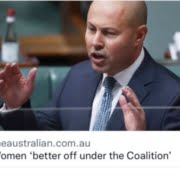
Recently, Treasurer Josh Frydenberg claimed that women were “ better off under the Coalition”.
This is not true.
The LNP Government has presided over one of the worst social crises ever to unfold in Australia.

Since the Coalition first came to office 2013, women aged 50 and over have become impoverished on a mass scale. There are over 400,000 women aged 50+ who are already homeless or at risk of becoming homeless. For some time now, older women have constituted the majority of those on Newstart/Jobseeker and they are on it for the longest periods.

For those who cannot believe that the situation is so bad, I refer you to https://lnkd.in/gXqxDXak

In short:

1. The policies of the LNP Federal Government have contributed significantly to this downward spiral for older women, including keeping Newstart/Jobseeker at $44 per day.

2. The LNP Federal Government has refused to address or take action to alleviate this suffering. One obvious example is that it has rejected budgeting for social housing.

3. The final ignominy is that just as older women are invisible in society, so too are they invisible to the Federal Government of Australia. There is no acknowledgement that the economic insecurity and social exclusion of women aged 50+ is a rapidly escalating social crisis in Australia.

Unseen Power of Women 50+ in the Next Election

The good news is that both parties now recognise that winning the women’s vote will be the crucial factor in winning the upcoming federal elections. Describing it as “pink-vis” instead of “hi-vis”, David Speers host of ABC Insiders, makes a good case for this in a recent article.

But the bad news is that Speers speaks mainly about young mothers in the 20-45 age group in marginal seats. He says that the parties know that “young women are more willing to shift their vote than older women or men.”

And with that he dismisses further discussion of the votes of older women.
Not so fast, Mr Speers.
You are right in saying women’s votes will determine the elections, but you are wrong in dismissing the impact of women voters who are aged 50+.

If loss of work is a reason to vote against the Government, then women 50+ have the most compelling reasons. They lost employment and more hours of work in the greatest numbers since the beginning of the pandemic. Unlike younger women for whom, as Speers writes, “fortunately many of these jobs quickly returned”, this did not apply to older women. They now make up the largest group on Jobseeker and they will undoubtedly spend much longer on it than any other group. This is because ageism keeps almost half of businesses from employing older workers, according to AHRC. Age discrimination is something older women have to deal with on top of all the other inequalities and disadvantage that women face in the workforce.

But this did not come into Speers’ reckoning because we are told that older women are unlikely to shift their vote. Can we also assume that they are unlikely to shift their vote now that over 400,000 of them have become homeless and over a million have been plunged below the poverty line? Can we assume that they are uninterested in which of the parties is prepared to take action on a crisis that impacts them predominantly?

Speers quite correctly spoke about the ageing population and the failure of the Government to deal with the inadequate and underpaid workforce in aged care. But what about the sector of the female population that is over 45 and not resident in aged care? This sector of women aged 50+ constitutes 35% of the total Australian female population of 12.9 million. But they are both overlooked and dismissed.

Over the last decade, Australian older women have suffered the worst impoverishment and economic insecurity in the greatest numbers since WW2. There will be political consequences for this.

All the parties will learn that it is a mistake to dismiss the voting power of women aged 50+.